
How to Improve Ad Relevance and Cut Wasted Spend
Improve ad relevance by matching intent, audiences, creative, and landing pages so more of your paid budget produces qualified leads...





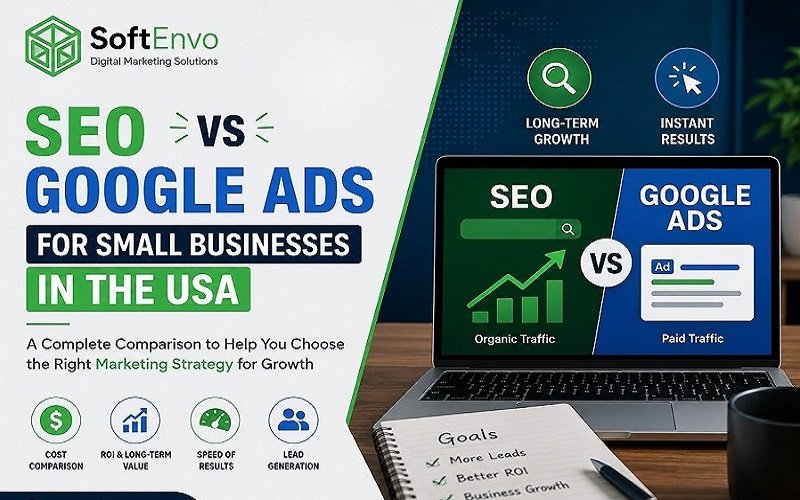
As a small business in the United States, you are likely to have asked yourself this question at some point in your life: Do I need to invest in SEO or Google Ads?
A just question and an important question. So many small businesses don’t have to unlimited marketing budgets. Each dollar must be put to good use. From small business like a local service company, professional practice, an E-commerce business, to an expanding home services business, you want a plan that attracts the right leads without spending time or money.
The problem is that both SEO and Google Ads are capable of helping your company expand, but they do so in vastly different manners. One is aimed at generating visibility in the long term in the organic search results. The other one will make you show up on the top of google as soon as you pay for clicks. Now, which one is more suitable for your business?
The answer: that depends on your objectives, timeframe, competition and budget. But when you grasp how each channel works, when you should use it and how it relates to the others, you can make a better marketing decision.
At Softenvo, we work with small businesses that want more qualified leads, stronger online visibility, and a better return on their digital marketing investment. In this guide, we will break down SEO vs Google Ads for small businesses in the USA in a practical way, so you can decide what is right for your business.
SEO (Search Engine Optimization) refers to the optimization of your website to rank higher in Google’s organic search results. Rather than paying Google for clicks, you become visible by producing content that is relevant, optimizing your pages, enhancing your web technical performance, and establishing trust signals around your website.
As an illustration, in case you own a plumbing company in Sacramento and somebody searches for “emergency plumber near me” or “water heater repair Sacramento,” robust neighborhood SEO can make your company appear in the map pack or natural outcomes.
SEO usually includes:
The biggest strength of SEO is that it helps you build long-term, compounding traffic. Once your pages start ranking, they can continue bringing in leads without you paying for every click.
Google Ads is Google’s advertising solution. It can make your company show up on the search results of particular keywords within a matter of moments. You don’t get traffic naturally, you have to pay to be seen and if people click your ad, you get paid.
As an example, if you’re a family law attorney in the Golden State, you can place your business on the front page of Google on a dime by appearing for searches such as “divorce lawyer near me” or “child custody attorney Sacramento.”
Google Ads can have:
The number one benefit of Google Ads is speed. If you have a good campaign setup, you can begin obtaining traffic and leads within just a few moments.
At a high level, the difference is simple:
But for a small business owner, the real comparison is deeper than that. You need to know which option is better based on cost, lead quality, speed, scalability, and long-term return.
Let’s break it down.
Google Ads wins if you need leads quickly
When leads are needed right now, Google Ads often provides a quicker route for your business. After you launch your campaign and it gets approved, your ads begin to show the same day. Google Ads is particularly useful when:
SEO wins if you are planning for long-term growth
SEO is not instant. It takes time to build rankings, authority, and momentum. Depending on your industry, competition, and website strength, meaningful SEO results often take a few months rather than a few days.
However, once rankings improve, SEO can keep delivering traffic and leads without ongoing click costs.
Best takeaway:
If speed is your top priority, start with Google Ads. If sustainable growth matters more, SEO deserves a serious place in your strategy.
Google Ads gives you immediate control, but costs can rise fast
Google Ads is an advertising service that allows you to set a budget and pay each time someone clicks on your advertisement. This may seem simple, but it depends on your industry, competition, location, and keyword targeting.
The U.S. has some businesses with very high cost per click (CPC). It is not difficult to see how the legal, dental, HVAC, roofing, and insurance keywords can add up quickly. Even though you’re spending your money, if your landing pages or targeting are shoddy, you’re not going to make good leads.
SEO requires investment, but traffic is not tied to every click
SEO is not “free.” There is still a need for strategy, content, optimisation, technical fixes and, in some cases, link building. But the difference is that once your content ranks, you’re not paying Google every time someone visits your website.
This is where SEO is appealing to many small businesses. This can also take longer in the beginning, but the cost per lead can get better as time goes on, due to the improved rankings.
Best takeaway:
Google Ads is good for getting tight short-term budget control and immediate visibility. SEO can be more cost-effective in the long run if you’re looking to free up traffic that you have to pay for in the long term.
SEO usually wins on long-term value
Long-term return on investment is one of the most prominent reasons small businesses invest in SEO. An optimized website can be optimized for a number of high-intent keywords, can bring back visitors, and can continue to help generate leads for the website on a month-to-month basis.
If your business is ranked on multiple local-service keywords and information queries around your business, you have several ways in which future customers can find your brand.
If you implement good SEO, it will provide benefits for a long time after you finish the optimization.
Google Ads can deliver ROI, but it stops when the budget stops
With proper management, Google Ads can deliver a solid ROI. However, there is a caveat: once you stop paying, the traffic ceases as well. The visibility is not retained after the campaign has ended.
This doesn’t mean that Google Ads is a bad investment. It just means that it’s a paid channel that’s more effective when it is active than when it’s in the long term.
Best takeaway:
SEO may offer a better return on investment in the long run if you want a reliable source of traffic and leads.
Both can drive qualified leads if done correctly
The point where many small businesses go wrong is here. They think that one channel is always better than the other. In fact, the quality of the lead is dependent upon strategy.
With high-intent keywords, compelling copy, and precise landing pages, Google Ads can generate leads of high quality. However, if targeting the right keywords is too general or negative keywords are not set, you could be getting visitors who don’t fit your website’s needs.
SEO is also capable of delivering great leads, particularly if your service pages are optimized for transactional keywords, and the content responds to actual customer inquiries. A user that found your business organically after searching for some help due to a problem would probably already have a higher level of trust in your brand by the time they reach out to you.
Best takeaway:
The quality of the lead isn’t so much about the platform, as it is about your intent, your messaging, and your landing page.
SEO often helps build trust more naturally
Organic searches are trusted by many individuals since they will often bypass advertisements in favor of organic searches. An enterprise featured in an organic search for certain searches can appear more reputable, authoritative, and credible.
Here is how SEO helps build reputation through multiple touchpoints:
Your credibility is built up each time your brand appears in search engine results.
Google Ads can still build trust, but only if the full experience is strong
Ads can bring people to your site quickly, but trust still depends on what they see after they click. If the landing page is weak, generic, slow, or confusing, the ad will not save it.
Best takeaway:
SEO tends to support trust and brand authority more naturally over time, especially for businesses that want to become the go-to option in their local market.
It’s not “SEO or Google Ads” for most American small firms, particularly those that provide services. Rather, the question is which one should come first, and how both will interact.
The choice of SEO as a better choice to invest in first could be beneficial when:
Google Ads may be the better first investment if:
However, it’s not always the case that one should take either one or the other route, especially for business owners. Instead, what’s more appropriate for many is taking advantage of the best parts of each one and blending them together.
This is a concrete example:
The SoftEnvo team usually takes this route when working with small businesses that want consistent leads without becoming reliant on paid search traffic.
If you want the most honest answer, it is this:
There is no universal answer for every business. A local roofing company, a dental clinic, an eCommerce store, and a law firm will not all need the same strategy. Your market, your competition, your margins, and your timeline all matter.
What does matter for every business is this: you should not make the decision based on hype. You should make it based on your goals, your budget, and the actual buying behavior of your customers.
SEO vs. Google Ads in the context of small American companies is not about determining which solution is objectively better. This is a matter of using the proper channel at different stages of the development process.
Google Ads allows gaining visibility promptly. When you need a persistent online presence, independence from paid clicks, and digital authority, SEO is one of the best possible options to invest in.
The most efficient approach to use in most cases involves understanding the way SEO and Google Ads channels complement each other rather than being rivals.
If you don’t know how to act, conduct an audit and determine your company’s goals, sources of traffic, level of competition in the niche, and lead generation needs. You will be able to create a strategy that fits your market rather than imitating something done by others.
At SoftEnvo, we help small businesses create practical digital marketing strategies built around real growth, not vanity metrics. Whether you need help with local SEO, Google Ads, website optimization, or a complete lead generation strategy, the right plan starts with understanding what your business actually needs.
SEO is more beneficial in terms of future business development and building up a company name, but Google AdWords will provide you with quick results. It all depends on your needs and budget.
It normally takes several months for SEO to make any effect, even more in competitive sectors. If a small business works within local SEO, then the effects should be visible sooner if their website and Google My Business profile are correctly optimized.
Yes, because Google Ads can work extremely well for small local businesses if campaigns are correctly set up and the page has a conversion.
Sure! And that is one of the most efficient ways to use both of these marketing tools..
Google Ads has direct per-click costs, while SEO requires ongoing investment in optimization and content. Over the long term, SEO can become more cost-efficient because you are not paying for every visitor.